A golf course feels harder when it is longer, when hazards like water, bunkers and trees sit close to where you want to hit the ball, when fairways are narrow and greens are fast or sloped, and when elevation and wind change how far the ball travels. It feels easier when you have room to miss, short forced carries or none at all, and greens that accept a less-than-perfect approach. Official course difficulty is measured with two numbers, the Course Rating and the Slope Rating, but how a course feels on the day also depends on which tees you choose and how you plan your round.
We think about this question a lot at Great Gorge. With 27 holes spread across a mountain ridge, a creek valley and an old quarry, we see golfers of every level walk off the 18th with very different stories. Some found it gentle. Some found it humbling. Most found it fun. Here is what makes the difference.
What makes a golf course harder
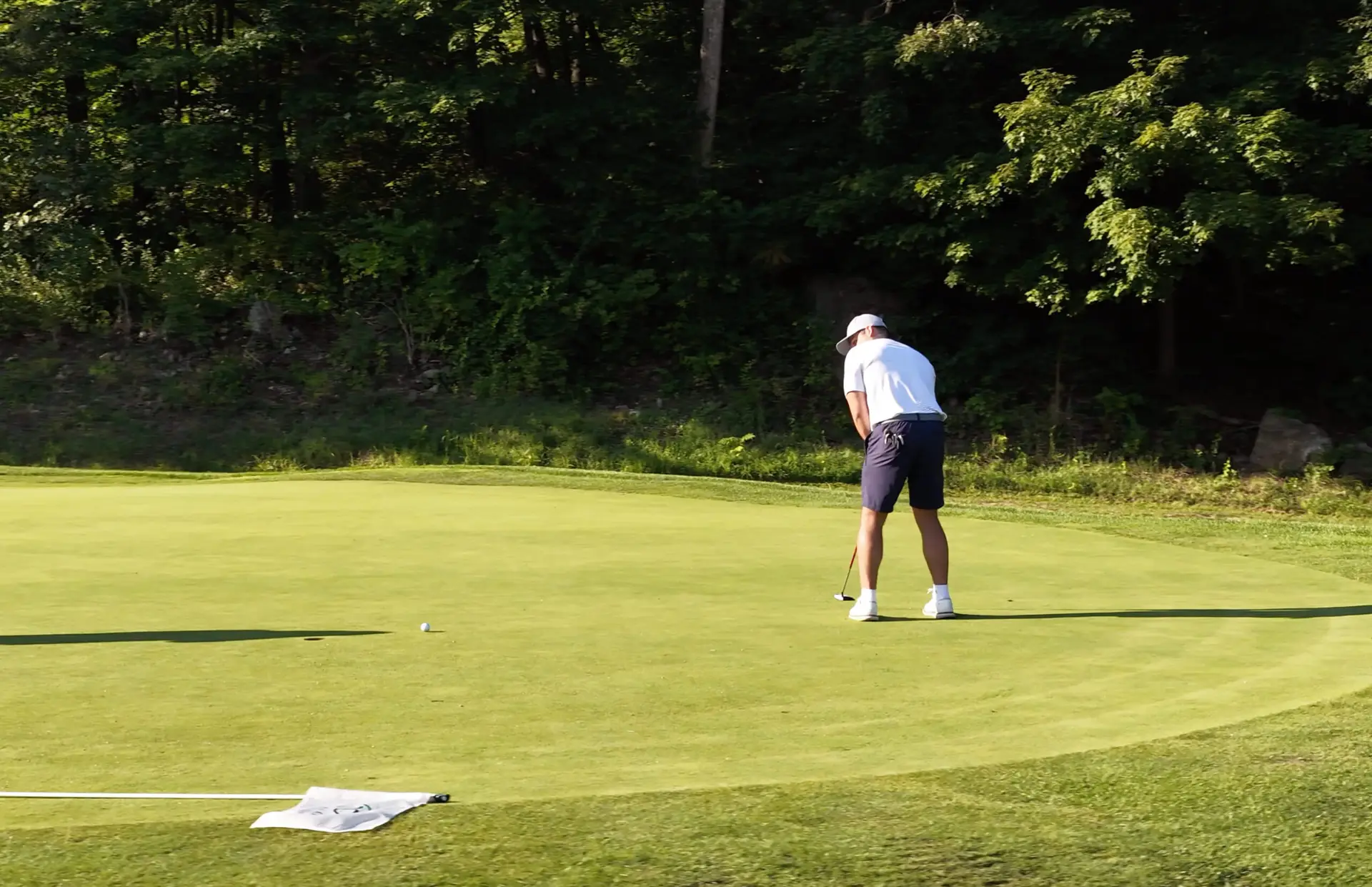
No single thing makes a course difficult. It is usually several factors stacking up on the same hole.
Length. The longer the hole, the more full shots you need and the more chances there are for one of them to go wrong. Length is the biggest single factor in how courses are officially rated.
Hazards close to the target. A pond 60 yards right of the fairway is scenery. The same pond tight against the green is a decision. Water, bunkers, out of bounds and trees all add difficulty, and they add the most when they sit where an average shot tends to land.
Forced carries. When there is no way to run the ball up and no safe route around, the shot has to fly a set distance. Forced carries over water feel especially demanding because the result is so clear.
Narrow fairways and heavy rough. Tight landing areas punish small misses. Thick rough, trees or rock along the edges make recovery shots harder, so one loose swing can cost two or three strokes.
Green speed and contour. Fast, sloping greens make every putt longer in your head, even when it is short on the ground. They also make approach shots harder because the ball has to land in the right section of the green, not just on it.
Elevation and wind. Uphill holes play longer, downhill holes play shorter, and wind can change the math on every shot. Courses in hills and valleys ask you to think about distance in a way flat courses do not.
Doglegs and blind shots. When you cannot see the landing area, or the hole turns sharply, you have to pick a line and commit to it. That uncertainty is part of why some courses feel harder than their yardage suggests.
What makes a golf course easier
The things that make a course feel easier are mostly the opposite of the list above:
- Wide fairways with room to miss
- Few or no forced carries
- Hazards that sit off to the side rather than in front of the target
- Open fronts to greens, so a low or short shot can still run on
- Greens that are smooth and true without being extremely fast
- Shorter tee options that match your typical distance
That last point matters more than most golfers realize. Playing the right tees is often the quickest way to turn a frustrating round into a good one.
Easier vs. harder at a glance
At a glance
What makes a golf course play easier or harder
| Factor | Plays easier | Plays harder |
|---|---|---|
| Length | Shorter tees, more short irons into greens | Longer tees, more long irons and woods |
| Fairways | Wide, with forgiving edges | Narrow, with rough, trees or rock nearby |
| Water and bunkers | Off to the side | In front of or tight to the green |
| Approach shots | Open fronts, room to run the ball on | Forced carries, raised or guarded greens |
| Greens | Moderate speed, gentle slopes | Fast and heavily contoured |
| Terrain | Flat, visible landing areas | Elevation changes, doglegs, blind shots |
| Conditions | Calm day | Wind, especially near open water |
How to measure golf course difficulty
If you want a number rather than a feeling, look at the scorecard for two ratings under the World Handicap System.
Course Rating is the score a scratch golfer would be expected to shoot from a given set of tees under normal conditions. A Course Rating of 71.5 means a very good player should average about 71 or 72.
Slope Rating shows how much harder the course plays for a bogey golfer compared with a scratch golfer. Slope runs from 55 to 155, and 113 is the standard. The higher the number, the bigger the gap between how good players and average players score, which usually means more trouble waiting for a missed shot.
Both ratings come from a detailed evaluation that looks at playing length plus obstacles such as topography, fairway width, the green as a target, rough and recoverability, bunkers, water, trees, the green surface and even the psychological effect of hazards. Every set of tees gets its own ratings, so the same course can be a comfortable test from one tee and a serious one from another.
How hard is Great Gorge?
We like to describe it honestly: Great Gorge is a thoughtful course, not a punishing one. George Fazio designed our 27 holes in 1970, and as a former tour winner he knew how to build holes that challenge good players while still giving everyone else a path to a good score.
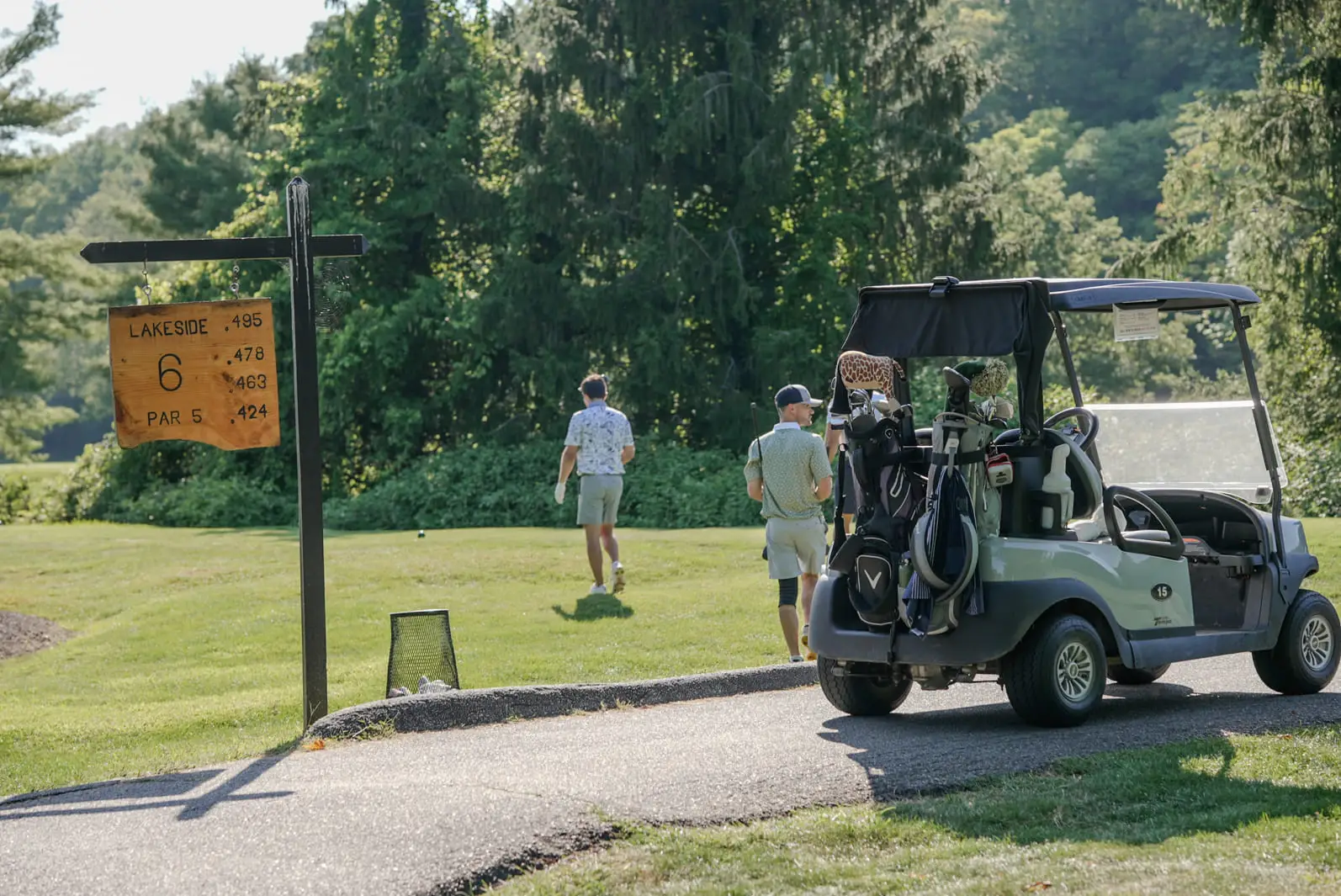
What makes each of our three nines different is the ground it sits on.
The Rail. Our Rail nine starts with a dramatic downhill tee shot and runs along the western ridge, where the fourth hole opens up into a wide landing area. Our eighth hole is called The Breather for good reason. The Rail does have the most bunkers on the property, 30 of them, so sand is the main thing to manage.
The Lake. Our Lake nine follows the lowest ground on the property along Black Creek, and water comes into play on six holes. It rewards a plan. On some holes, like the third, the marsh on the right is almost always out of play, and knowing that makes the hole feel friendlier.
The Quarry. We call the Quarry our most demanding nine. It is built into rock, with tight, winding fairways, sharp angles and The Wall, a par 3 with a long forced carry over water beside the old quarry wall.
Our 27 holes
How the Rail, Lake and Quarry compare
| RailTHE RIDGE | LakeTHE VALLEY | QuarryTHE ROCK | |
|---|---|---|---|
| Blue tees | 3,393yds | 3,340yds | 3,252yds |
| White tees | 3,022yds | 3,041yds | 2,779yds |
| Red tees | 2,798yds | 2,653yds | 2,555yds |
| Bunkers | 30 |
21 |
22 |
| Holes with water | 4 |
6 |
5 |
| Main challenge | Elevation and sand | Water and strategy | Accuracy, rock and forced carries |
Bent grass greens on all 27 holes. Any two nines combine for an 18-hole round.
Notice that the Quarry is the shortest of the three and still the hardest. That is a good reminder that length is only part of the story.
All three nines share our bent grass greens. Reviewers on our reviews page have described them as “quick and tough,” so a few minutes on the putting green before you tee off is time well spent.
For a gentler 18, we suggest pairing the Rail with the Lake. If you want the full test, include the Quarry. You can see maps and details for each nine on our courses page.
Looking for easy golf courses near you?
If you are searching for an easy golf course near you, it is worth knowing that “easy” depends as much on how you play a course as on the course itself. A few simple choices can make almost any round more enjoyable.
Choose the right tees. If your driver usually travels under 200 yards, the forward tees will give you more of the shots you enjoy and fewer long carries.
Play away from trouble. Aim at the fat part of the green rather than a tucked flag. A 30-foot putt is far better than a recovery shot from a bunker.
Leave the driver in the bag when the hole asks you to. On a short, tight hole, a hybrid or long iron that finds the fairway beats a driver that does not.
Warm up first. Our driving range is natural grass with targets from 100 to 250 yards, and our putting and chipping green is rolled daily. If you want to work on your swing in more depth, our guide on how to achieve the perfect golf swing explains how to adjust for uphill, downhill and sidehill lies like the ones you will find here.
Try a shorter format. If you are just starting out, or bringing family members who do not play much, 1Club Park Golf is played with a single club and a larger ball. It takes about two hours and is a relaxed way to enjoy the game without the pressure of a full round.
Golf is meant to be enjoyed, and we would much rather see someone leave with a smile and a story than a perfect scorecard. Whatever your level, our team is here to help you have a good day out.
What makes a good golf course
A good golf course is not necessarily an easy one or a hard one. It is one that stays interesting. The best courses give you choices, reward a good shot, forgive an average one and make you want to come back and try a different line next time.
What makes a golf club good goes beyond the holes. Course conditions, friendly staff, a place to eat and talk about the round, and a setting you look forward to driving into all matter. That is what we work toward every day at Great Gorge, from our greens to the views across Vernon Valley. If you are planning a longer visit, our golf weekend getaway guide shows how to turn a round into a full weekend in the Skylands.
Frequently asked questions
What makes a golf course difficult?
A golf course becomes difficult when several factors combine: long holes, hazards close to the target, forced carries over water, narrow fairways, fast and sloping greens, and elevation changes or wind that affect distance.
How is golf course difficulty measured?
Difficulty is measured with the Course Rating and the Slope Rating. Course Rating estimates what a scratch golfer would shoot. Slope Rating, which runs from 55 to 155 with 113 as the standard, shows how much harder the course plays for a bogey golfer.
What makes a golf course easy?
Wide fairways, few forced carries, hazards placed to the side rather than in front, open green fronts and moderate green speeds all make a course play easier. Choosing tees that match your distance helps too.
Is Great Gorge good for beginners?
Yes. We welcome golfers of every skill level. Beginners can choose forward tees and start with a gentler pairing such as the Rail and the Lake.
Which nine at Great Gorge is the hardest?
The Quarry is our most demanding nine. It is the shortest of the three, but its tight fairways, rock walls and forced carries make accuracy more important than distance.
How long is an 18-hole round at Great Gorge?
It depends on which two nines you combine and which tees you play. From the blue tees, the Rail and Lake pairing is the longest at 6,733 yards. From the red tees, the Lake and Quarry pairing is the shortest at 5,208 yards.
When is Great Gorge open?
Our primary season runs from April through September, and during peak season we are open seven days a week, with hours that follow the daylight. Current hours are posted on our website and at the pro shop.